If kings were immortal beings, succession would never be a topic meriting discussion. Despite the attempts by kings, since time immemorial, to stretch their mortality—some bordering on lunacy, such as the construction of mammoth pyramids by the pharaohs of ancient Egypt—every king reaches a time and the curtain falls on their tenure. This, inevitably, calls for a new king to assume the reins.
In some instances, however, the shoes of their predecessor turn out too big for the new king to fill, even a long legion of successors. It is no mean feat succeeding a legendary king. This has been the reality at Arsenal football club since the departure of Thierry Henry—King Henry, if you will.
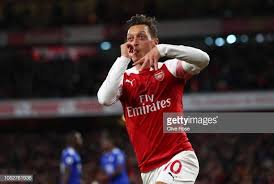
A long line of suitors have staked their claim to the throne at the Emirates. Jose Antonio Reyes (RIP), Theo Walcott, Robin Van Persie, Mesut Ozil, and Pierre-Emerick Aubameyang, have been among the notable names flirting with the throne departed by King Henry. Despite being highly talented, none of these individuals have scaled even close to the mercurial heights of Thierry Henry at Arsenal.
What sets King Henry apart from his long line of wannabe successors? Thierry Henry was Arsenal, and Arsenal was Thierry Henry. Period. If someone mentioned “Henry’s team”, only one interpretation would suffice—you would be a retard to think the reference was to the French national team. Henry was the unequivocal Mr. Arsenal.
This is not to suggest that Arsenal was a one-man team in Henry’s era. In fact, Henry had at his disposal an invincible (pun intended) supporting cast in Pires, Vieira, Ljungberg, and Bergkamp. But Henry was unique in one way: Henry personified Arsenal. The whole team played for Henry, and Henry played for the whole team. Despite not being team captain until the last days of his Arsenal career, Henry’s charisma was only matched by his performance on the pitch. Henry was the fuel that propelled the team.
The long impatient wait for another Henry among the Arsenal faithful has led many to believe that no another player will scale similar heights at Arsenal. Considering the loud hype invariably followed by underwhelming performances that has characterised all the mooted successors to King Henry’s throne, this pessimism can be forgiven.
The wait could be over.
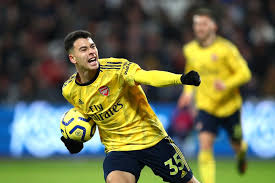
Forget all the wannabes! The rightful heir to King Henry’s throne is an 18-year old Brazilian prodigy. Despite being overshadowed by the marque signing of Nicholas Pepe during the 2019 summer, Gabriel Martinelli’s transfer from Brazilian side Ituano has turned out to be the shrewdest piece of transfer business Arsenal have pulled off in recent times. For a measly £6m, pocket change in today’s transfer figures, Arsenal acquired a player that Liverpool manager Jurgen Klopp would christen “the talent of the century”.
The only parallel between Henry and Martinelli is not just that both play in winger-cum-centre- forward role. Like his predecessor, Martinelli is gifted with one innate character that separates great players from the chasing pack—passion, hunger, attitude, chutzpah, call it what you may. In praise of Martinelli’s desire to chase down every lost ball, interim Arsenal head-coach, Freddie Ljungberg, befittingly compared him to a Duracell battery.
Assuming a normal development curve, Martinelli even rates higher than Henry. Let’s not forget that despite joining Arsenal as a 22-year old world cup winner, Henry initially struggled to find his footing, in the English game. Contrast this with the samba boy’s electric start to life at the Emirates, highlighted by seven goals in the first seven games. It is not an exaggeration to assert that, at 18-years, Henry would understudy Martinelli had they been age mates and played in the same team.
Will Martinelli live up to his billing? Will he succeed where so many next-Henrys have failed? The jury is still out, but I have already passed my verdict: Martinelli is the next king at the Emirates.
The current times will be defined in the annals of history as the COVID-19 era, or something along the same connotation, no doubt. The COVID-19 pandemic has monopolised press coverage, and not without cause. With current infections precariously shy of the 3 million mark, one in ten of whom constitutes the mortality number, that COVID-19 has been devastating is no understatement.
What has surprised all and sundry, perhaps even more surprising than the stealth way in which COVID-19 emerged, is the ease with which the most sophisticated healthcare systems have been laid bare. That countries in the proverbial global north, such as UK, Italy, and USA, ostensibly with the finest healthcare systems humanity can offer, could be brought to their knees—to the extent of accepting aid from arch-rival Russia—is a story for the record books.
The anti-climax to the COVID-19 tragedy has been the virtual lockdown of entire economies to curtail further contagion. Who could have imagined the capitalist West shutting down their famed free economies?
Amidst the hullaballoo surrounding the COVID-19 pandemic, it is quick to forget that a more devastating pandemic has been omnipresent for the past 30 years and still counting: HIV/AIDS. The mortality numbers of COVID-19 look like a joke when juxtaposed with the 32 million lives claimed by AIDS. The fact that the overwhelming bulk of AIDS related deaths have been confined to a single geographical region, Sub-Saharan Africa, adds even more angst to the AIDS story. Conversely, COVID-19 has rapidly spread across the globe, despite USA president Donald Trump’s ill-humoured efforts to christen it the “China virus”, lessening the net impact on any single region.
Another distressing statistic is that AIDS mainly claims the most active segment of the population. Whereas the COVID-19 mortality ratios are hugely skewed towards the retired elderly (I do not suggest that elderly lives are unimportant), majority of AIDS victims are in the age range of 15-49 years. The comparatively more devastating impact of AIDS on human capital productivity can easily be discerned from this grim statistic.
Why would, AIDS, a pandemic so vicious to claim millions of lives not attract global cooperation on the same scale as COVID-19 has? Is it because COVID-19 has a higher mortality ratio than AIDS? No. Is it because AIDS has stayed with us for so long that the world has been distracted by other priorities? Perhaps. Is it because the big boys in the global north have not been significantly impacted by AIDS? Probably.
The fact that COVID-19 has caught everyone unawares, from the developed countries to the third-world, plausibly justifies the humongous effort that has been directed toward fighting the pandemic, unlike other pandemics. One significant lesson from the COVID-19 pandemic has been the stark reminder that no nation is wholly self-sustaining. Who could have imagined USA begging for face masks from China?
Another notable peculiarity with the COVID-19 pandemic has been the urgency which has been accorded to the effort to invent a cure. From big Pharma to the tropical traditional healer, no suggestion seems too stupid at this moment—Trump’s ludicrous suggestions being the lone exception. That the Malagasy traditional herbal tonic championed by Madagascar’s president, Andry Rajoelina, as a cure for COVID-19 has been hastily procured for trial by four other governments—never mind the hushed warnings from WHO—would be absurd at any other time. But this is not any other time: this is mission critical.
The commendable concerted effort directed towards mitigating COVID-19 opens a puzzle in my mind: What if the world had invested the same magnitude of effort towards fighting AIDS? What if scientists had mapped up the HIV genome sequence early enough and come up with a standard test within days? What if communal HIV testing and aggressive contact tracing had been swiftly adopted? What if the first carriers of HIV has been swiftly identified and isolated from the population? What if HIV screening of all incoming foreign passengers had been made mandatory?
Since the levels of technological advancement between the respective times of the initial phase of the AIDS pandemic and the COVID-19 pandemic are far apart, it is not feasible to do an apples-to-apples comparison of the respective interventions deployed.
However, one thing is apparent. If the collective global effort deployed in the AIDS fight had been on the same general scale as being exhibited during the COVID-19 fight, we would have fewer tombstones in the graveyards.
As my mind wandered about trying to make sense of the anarchy that the COVID-19 pandemic has thrust the world into, the foregoing question came to mind.
Whereas the World Wars I and II involved barbaric physical artillery, the current phase has been more subtle: USA president Donald Trump aptly refers to COVID-19 as “the silent enemy”. Notwithstanding, COVID-19 has been no less devastating—potentially, at least.
A death toll exceeding 200,000—and still counting—is a calamity of historic proportions, more so given that COVID-19 only came to the attention of the world in January 2020. To this humongous carnage add the looming global economic meltdown and one will appreciate the true extent of the pandemic.
Another striking similarity with the previous World Wars is the fact that the current phase has its initial frontline in the superpowers of the day. Whereas the primary protagonists in World Wars I and II were Germany and the Allied Forces (Europe and USA), the initial leg of the COVID-19 battle has involved China, Europe (Italy, Spain, Britain, France), USA, and Russia. The only disparity here is that every country is on the same side in the COVID-19 war.
Akin to how different fronts were quickly opened up in far-flung locations worldwide during World Wars I and II as the lead actors stretched the frontline—effectively turning regional skirmishes into world wars—the COVID-19 frontline has spread out to all corners of the world. As per the current official tally just less than twenty countries worldwide remain unscathed by the COVID-19 pandemic.
Like World Wars I and II had in Kaizer Wilhelm II and Adolph Hitler their villains, COVID-19 has already recorded its fair share of villains. Per current standings, the contest for the ultimate prize is between Trump and maniac Brazilian president Jair Bolsonaro.
Trump, being Trump, has contradicted himself at every plausible opportunity. First he dismissed COVID-19 and vowed he would never close down the economy. In quick succession, he changed stance and started taking the pandemic seriously—only briefly. The next time he was attracting the scorn of healthcare professionals by prescribing to the nation cures which had no scientific basis. Ultimately, as if to admit his own inability to offer leadership to the country, he passed the buck to state governors to untangle his mess. That Trump was later to support demonstrations against lockdown measures instituted by state governors is the perfect definition of villain. Trump’s shenanigans would be good stuff for late night comedy show had it not come at a sombre moment.
However, it is Bolsonaro who currently has the edge to the villain crown, despite strong competition from Trump. The Brazilian president will relish controversy whether it means putting the lives of his countrymen at risk. From consistently downplaying the virus as “a little flu”, to dismissing the advice of his own healthcare technocrats, Bolsonaro’s lunacy has no limits. The ex-army captain shocked the world when he joined a protest against lockdown measures instituted by his own administration to curb the spread of the corona virus. The fact that, with over 66,000 confirmed COVID-19, including close to 5,000 deaths, Brazil is the epicentre of the pandemic in the southern hemisphere is not enough to bring sanity to Bolsonaro. When faced with an insurmountable enemy, good commanders retreat to preserve their troops for another battle: Bolsonaro either missed this lesson in his military training or knows something no one else in the world knows.
As in World War I and II, and indeed any other war, the COVID-19 pandemic has given birth to a cocktail of propaganda and conspiracy theories. The valiant exploits of Nazi spin-doctor Joseph Goebbels during World War II are well documented in the history books. Except that the cloak of anonymity offered by social media has added another dimension to this domain during the COVID-19 pandemic.
One conspiracy theory that stands out of the labyrinth of information in the public domain surrounds the origins of the novel corona virus that causes COVID-19. Claims that this virus is a product of biological warfare have been prominent with fingers pointing in turns at USA and China. The latest twist in this blame-game was Trump accusing China of misdemeanour, a claim that was roundly dismissed as Trump at his hidebound best. The propagation of this conspiracy theory is helped by the fuzzy school of thought adopted by the mainstream consensus that the virus traces its origins from an animal market in Wuhan, the Chinese City that recorded the first COVID-19 case.
My mind has failed to find peace in the Wuhan animal market school of thought for two reasons. First, the Wuhan natives have for ages derived culinary gratification from the same delicacies that are being accused of having vengeful transferred the virus to the still anonymous patient zero. Why is it only now that the virus found the wisdom to find another host? Secondly, with the benefit of decades of top-notch virology research, it is highly implausible that our esteemed worldwide scientific community could have failed to establish this seemingly discernible transmission chain beforehand. My scepticism is further nourished by an opinion I chanced upon from one of the world’s leading virology experts that no hard-and-fast transmission chain from any of the accused Wuhan animals has yet been established.
I will not join the conspiracy theorists. But one thing is certain: If the COVID-19 pandemic is a war, then it bears the hallmarks of a World War.
One of enduring legacies of the first industrial revolution is the advent of the office. The office has become so much entrenched in mainstream culture that “going to office” has become synonymous with “going to work”. To maximise labour economies of scale, industrial revolution capitalists established offices, wherein, for a specified daily duration, they would encamp all their workers into clustered workstations proverbially known as cubicles. Fitted with a desk, chair, and essential work tools, the size of which depended on seniority, the cubicle was to become the worker’s abode for the next two centuries.
The cubicle arrangement worked since it afforded the business owner the opportunity to superintend over his charges and ensure that he was getting his end of the deal—that the employees were putting in the required shift. On their part, the employees were willing to trade-off their physical freedom for the assurance of a pre-agreed monthly stipend in exchange for their time. Fair deal—at least not until one party, more often the employer, decides to exploit their partner.
Trust human ingenuity. Toward the end of the 20th century, a novel invention that was to offer unlimited possibilities in terms of work location came into our midst—the internet. The internet made it possible for two people without physical proximity to share documents in an instant. By the beginning of the 21th century, internet based innovations like e-mail had become indispensable elements of mainstream business culture. This challenged the viability of that daily commute to a cubicle to do work that can be done from anywhere in the world with internet access.
However, man is a creature of habit and is wont not to fix what is not broken. Despite the obvious benefits of working remotely, employers were reluctant to dispense with the tried and tested method of working in collective onsite workstations. Barring a few early adopters, like the disruption centric Silicon Valley, majority of employers continued to cage up their employees in cubicles, and tossed remote working arrangements to the ambivalent future.
Boom, the COVID-19 pandemic strikes! Remember economics of space optimisation had compelled employers to cram employees into closely packed cubicles. This renders the traditional office spaces non-amenable to the social distancing guidelines prescribed by healthcare professionals. To preserve humanity from extinction, governments have no option but to impose stringent lockdown restrictions and confine employees to their homes.
In a vain attempt to keep their conveyor belts running, employers scamper to adopt what had all along been mooted as a more efficacious mode of working—remote working—only that they did not care less to pay heed. Alas, time is not on their side. Given the abrupt nature of the pandemic, employers can not immediately migrate their physical offices to the internet—a culture that has been ingrained for two centuries cannot be adjusted in hours. Consequently, whole economies shut down.
The current predicament could have been avoided at very minimal cost. Many are shocked to belatedly learn that Zoom, the internet application that enables meetings to be conducted remotely, only requires internet connectivity to use—same with Skype. How come we did not know all along?
Every cloud has a silver lining. The COVID-19 experience should force us to rethink whether we still need cubicles in the 21st century. Why does society force hordes of workers to endure tortuous commutes to and from work when they can work from the comfort of their living rooms? Why should companies take out expensive real estate leases to accommodate staff who would be happy to work from their own accommodation?
Do we still need to work from cubicles in the 21st century?
In the rumble-and-tumble of the COVID-19 pandemic, professional football has been one of the most scathed. The person-to-person transmission nature and high contagion effect of the novel corona virus, the virus that causes COVID-19, renders the prevailing practice of playing football matches in closely packed open stadia unfeasible—challenging at best.
COVID-19 will definitely not leave professional football the same. It is time football stakeholders explored disruptive ways in which the game will inevitably be impacted. Below I forecast the 12 ways in which the pandemic will have a long-term impact on the professional game:
1. Multi-million Pound Stadia Will Become Concrete White Elephants
From the early 2000’s onwards football clubs especially in England went into a frenzy of borrowing hundreds of millions of pounds to construct state-of-the-art stadia. The latest is Tottenham Hotspurs’ 1 billion pound stadium completed in 2019. This was in the anticipation of making a windfall in match day revenues.
To maximise match day earnings, modern stadia are designed to optimise occupancy. However, with the post-COVID-19 social distancing requirements of 2-metre (4-metres, according to some sources) between every two individuals, stadium capacity will fall under ten per cent of the design capacity. Indeed plans are being mooted to allow a maximum of 300 spectators in the stands upon resumption of the German Bundesliga. Imagine 300 hundred spectators in a stadium designed for a capacity of 60,000!
COVID-19 will therefore render the economics of stadium ownership unviable. Spare a thought (and prayer) for clubs which are still servicing their enormous debts arising from stadium construction loans.
2. Football Will Go Digital
Taking a lead from the English Premier League, domestic football across Europe attained a global reach thanks to satellite television in the post-2000 era. Nevertheless, flocking to the stadium remains the premier (no pun intended) way of catching a dose of football therapy from one’s favourite team by football addicted fans.
With the remainder of the 2019/2020 season across Europe expected to be played behind closed doors, fans will have no option but to catch the action on pay television or internet. This trend is most likely to extend into the next season, since a mass COVID-19 cure is only expected at least after 12 months, by the most optimistic projection. This will compel the fans to acclimatize to an alternative way of enjoying their favourite pastime—moreover cheaper than trekking to the stadium.
Having acclimatized to a more convenient and cheaper way of enjoying football, it will take a lot of pitching to attract fans back to the terraces post-COVID-19. Moreover, with the trauma of COVID-19 still fresh in their minds, fans will be reluctant to flock to closely packed stadiums.
3. No More Spitting
Football players are fond of spitting onto the football turf and blowing out into their shirts. This otherwise socially unpalatable habit is more of a biological response than poor appreciation of etiquette—the reason it has been accepted (perhaps ignored) as normal practice by an otherwise discerning public.
Since we now know that this is the most lethal way of transmitting the corona virus, how are we going to tell our footballers to suppress this reflexive biological urge? The spontaneity of this action rules out the option of introducing spitting breaks (Gosh! Did I write that?). This is a big catch.
I will be least surprised when, soon, I see a referee pull out a card and roar: “You are booked for spitting!”
4. The Terraces Will Go Silent
Football has been known for the rambunctious atmosphere in the stadium terraces, with dangerously high decibels of noise emitted by the fans in passionate support of their favourite team. The proverbial twelfth man is so characteristic of football that teams are perceived to enjoy a higher chance of winning in front of their home crowd. Whoever doubts this, ask any visiting team that has played at Anfield, in front of Liverpool’s notoriously passionate fans.
The spectacle of a full-capacity stadium with strangers positioned in body-hugging proximity, shouting their lungs out into each other’s faces, can only be a relic for the history books in the post-COVID-19 era. One after effect of COVID-19 will be the paranoia of people perceiving everyone in their close proximity as hosting the most potent strain of the corona virus. This will kill the lively atmosphere in the stadium.
It is not farfetched to foresee football the football stadium of the future populated by solitary old men in brim hats silently sipping at their straws.
5. No More Ceremonial Pre-match Handshake
This is the easiest prediction to make, basing on the fact that it was one of the temporary measures instituted before suspension of football games in the immediate wake of the COVID-19 outbreak.
The pre-match handshake between opposing players and managers has been long adopted as a gesture of sportsman in football protocol. This practice has been acceptable since it is in line with general social norms—a handshake is a formal greeting and gesture of peace in most cultures worldwide. If you think the pre-match handshake is merely a ritual, recall the intense enmity between Luis Suarez and Patrice Evra arising out of a snubbed handshake.
With shaking hands proven as one of the most common modes of transmission of the corona virus, it is time to rewrite the rules.
6. No More Sharing Water Bottles
One of the unwritten rules of sportsmanship on the football pitch is that players share water—teammates and opponents alike. Whenever there is an injury break both sets of players customarily rush to the summoned physician’s bag and quench their thirst, randomly passing around the bottle to the nearest player.
In as much as we enjoy the sight of such display of sportsmanship, this is one of the practices that will likely be flagged off as risky in light of COVID-19.
7. Wearing Hand Gloves Will Become Mandatory for Players
During cold weather, sometimes players have been wearing had gloves to preserve their body temperature. However, this has been a matter of individual convenience not a requirement. Drawing from the fact that few players opt to wear hand gloves, this is not a popular choice among players.
Post-COVID-19, it is highly plausible that wearing gloves will no longer be left to the individual player’s discretion. For the sake of hygiene, I foresee hand gloves being added to the list of the mandatory footballer’s gear.
8. Wearing Masks Will Become Compulsory in the Terrace
One of the most radical lifestyle choices imposed upon society by the COVID-19 pandemic is the adoption of face masks as essential everyday gear. Worldwide people are being encouraged, at times compelled, to wear face masks whenever going out to public places. Football stadia will be no exception.
Given the fact that football crowds are drawn from diverse localities, the odds of preventing COVID-19 contagion in the stadium will be much heightened as contact tracing is very difficult in such likelihood. In light of this, I foresee wearing a face mask being introduced as a mandatory requirement for admission to the football stadium.
9. Sitting Arrangements Will Change
Traditionally, terrace seats in the football stadium are arranged end-to-end to maximise capacity. With healthcare professionals advising a safe physical distance of at least 2 metres (4 metres, by some suggestions), it is highly implausible that the current sitting arrangement in football stadia will be given a clean bill of health.
Most probably new public health rules will be instituted requiring stadium owners to re-engineering the sitting arrangements.
10. Teams Will be Subjected to Pre-match COVID-19 Tests
This is another easy prediction. A no brainer!
The introduction of pre-match COVID-19 tests has featured very prominently among the proposals tabled by various leagues in devising ways of completing the 2019/2020 season. It is most unlikely to see this proposal not being adopted.
11. Hand Disinfection Will Become Part of the Pre-match Routine
The introduction of mandatory pre-match hand disinfection looks logical in the prevailing circumstances.
Though hand disinfection is considered an ordinary social practice the quick spread of COVID-19 has demonstrated that it is not done as routinely as we hitherto believed it to be. With the critical importance of this would-be basic practice highlighted in breaking the chain of transmission of the corona virus, what about if it is introduced as part of the pre-match routine?
I am sure there are decision makers in the respective football league bodies who are at least half as smart as I am and will see the wisdom in this proposal.
12. There Will More Stricter Measures Against Pitch Invasion
Which football follower has never witnessed a scenario during the game where a vagabond abruptly jumps over the barrier from the stands, beating pitch side security and sprints across the pitch? I must admit, I find this amusing at times—especially when the game proper is boring.
But wait a minute! What if this pitch invader is the biological version of a suicide bomber with the deliberate intention of infecting players with the corona virus? After ruminating through this likelihood, stadium security will act stricter to protect players from this threat.
The year was 2008; June 17, 2008 to be precise. FC Barcelona, one of the premier clubs of European football had departed from tradition: they had appointed a novice as their next manager. For a club of Barcelona’s pedigree this was unheard of. The fact that Josep Guardiola, the man who had been announced as the new manager, was no stranger at the Nou Camp—a club legend—did little to soothe criticism of this decision. Detractors had their field day.
The news that Jose Mourinho, then the poster-boy of elite European club management, had been overlooked in favour of Guardiola added another twist of irony to Barcelona’s latest managerial appointment. Not even the most amenable optimists could be convinced that Barcelona had got this decision right. Implausible by many, the Barcelona hierarchy had played their cards right.
The appointment of Guardiola had not been made in haste. After the Johann Cruyff’s wildly successful tenure of 1988-1996, Barcelona opted for many tried and tested managers to carry forward its legacy as one of Europe’s elite football clubs. However, under Cruyff, Barcelona operated on a hard-set tradition which successive managers either failed to adapt to or unsuccessfully tried to depart from. After a succession of underwhelming appointments, the Barcelona hierarchy thought it was time to revive the mainstream Cruyffian philosophy. What better way than appoint a protégé of Cruyff to do the job?
As the cliché goes, the rest is history. Guardiola went straight to work reviving his mentor’s core footballing philosophy—total football. Guardiola would go on to win an impressive haul of 14 trophies in 4 years—even surpassing Cruyff’s tally.
Guardiola’s impact was not just felt at the Camp Nou. Taking a lead from Guardiola’s overwhelming success in his debut managerial appointment, elite European clubs warmed to the idea of appointing rookie former star players as managers. The most prominent maverick managerial appointment include: Zinedine Zidane, Genero Gattuso, Frank Lampard, and Mikel Arteta.
Experience has been long accentuated as an indispensable prerequisite to a managerial appointment at a top club. Hitherto, the orthodox route for a football manager would include starting his career at their former or local town club, probably with the underage or reserve teams, then graduate through a succession of bigger local clubs, and ultimately move abroad. Arsene Wenger, Louis Van Gaal, Jose Mourinho, Carlo Ancelloti, Jurgen Klopp,…most of the renowned managers have beaten this familiar path. However, the current trend of rookie managerial appointments seems to upend this logic.
Rookie managerial appointments are particularly successful in elite European football of late due to two key reasons. First and foremost, being a club legend, such managers enjoy goodwill and respect among the entire club structure—from management to fans—and are already familiar with the culture. Fans in particular are very sentimental towards their heroes of yester years and will be reluctant to humiliate them. Without discounting Guardiola’s individual acumen, his success was in no small part to the fact that he was a cult-hero among the fans and was already familiar with the internal workings at Barcelona and—two luxuries that were not enjoyed most of his predecessors after Cruyff. Barcelona, in particular, is a closed cult that does not treat outsiders with kindness.
Another factor that plays into the hands of rookie managers is the fact that the position of football manager has evolved more into a figure-head role. Elite clubs can afford to employ a high calibre technical team which takes most of the coaching burden off the manager. The role of manager is increasingly becoming literal in a sense that his key responsibility is more to coordinate the coaches on his backroom staff than do the hands-on coaching. Therefore, to make a good manager at an elite club one needs more human relations than technical aptitude. The diminishing role of technical aptitude has correspondingly diminished the importance of experience in the progression to top management. A manager does not necessarily need to acquire by themselves decades of experience to succeed when they can outsource it from their technical staff.
Based on the foregoing reasons, I foresee an increasing number of rookie managers assuming the reigns at top football clubs across Europe. I highly doubt Wenger, Mourinho, or Klopp would ascend to the heights they have attained in management if they were starting out their careers today. The ideal football manager of the future will be the charismatic former player.
Forget the uncomfortable distraction of COVID-19. Let’s talk football.
The 2020 summer transfer window is around the corner. Will it open in June, July, August, September, or beyond? A thick cloud of uncertainty looms large.
Undeterred by the uncertainty, clubs across Europe are earnestly doing their homework on prospective transfers and raring for a piece of the action.
One subject of transfer speculation that has, arguably, garnered the widest press acreage is Pierre-Emerick Aubameyang. Gauging from press coverage, it is not farfetched to surmise that Arsenal’s Gabonese striker is currently European football’s hottest property.
Characteristic of anybody in possession of a prized asset, Mikel Arteta, Arsenal’s head coach, has been jealously vociferous in asserting his desire to keep his leading marksman. Arteta’s justification for keeping Aubameyang is plain to all. Which coach would not want to keep the striker with one of the best goals per minute ratios in the history of the premier league?
I beg to differ. Despite Aubameyang’s impressive statistics, keeping Aubameyang longer may prove to be a poisoned chalice for Arsenal. Below are 10 reasons why I believe Arsenal should cash in on Aubameyang in the 2020 transfer window:
1. Age is Not on His Side
Make no mistake! Aubameyang is in the prime years of his game. Otherwise he would not attract the fancy of heavyweights of the European game, such as Real Madrid, Barcelona, Manchester United, and Manchester City.
However, as most often is the case, clubs tend to hold onto their prized assets a little too long and end up stuck with a player on a bloated wage without an output on the pitch to match. This is a mistake Arsenal needs to avoid.
Despite his current mercurial heights, turning 31 years, Aubameyang is undoubtedly heading downhill. It would be far-fetched to fathom Aubameyang performing at his current level beyond the next 2-3 years. Now, therefore, is the perfect timing for the club to move him on and boast the transfer kitty by at least 30m euros. This money could, if effectively redeployed, generate wider impact on the team.
2. Aubameyang Offers Little Beyond Goals
Aubameyang gets the goals—no dispute!
However, the modern game has evolved in a way that every player has to be a jack-of-all-trades (if you will). It is no longer enough for a striker to put the ball behind the line and garner full plaudits. Modern-day strikers are as much judged by their contribution in build-up play and defence. Well-rounded strikers are particularly useful to their team in defending opposition set pieces owing to their perceived aerial prowess.
Aubameyang falls sorely short in his defensive contribution. Though strides have been made in improving this aspect of Aubameyang’s game under Arteta, you cannot teach an old dog new tricks—it is not easy, at least. Arteta’s grooming efforts would be better spent on a younger lad like Nketiah.
3. It is Futile to Court a Suitor Who Believes You’re Not Good Enough
Anyone who has dated knows the truth in the foregoing statement.
Let’s face it—Arsenal stands no chance when Europe’s big boys covert a player and come calling. Arsenal is the less desirable option for a player who is at the prime of his career and is being courted by Real Madrid and Barcelona, among a long bevy of suitors. Arsenal will neither match the big clubs in wages nor trophy prospects—two of the most critical considerations in any reasonable player’s transfer decision.
With the possibility of a camel going through the eye of a needle more plausible than the prospect of Arsenal qualifying for the champions league after the 2019/2020 season, it would be a miracle if Aubameyang did not attempt to force through a transfer.
Hard as is, it will be more sensible for the club to let Aubameyang leave for a club he feels is more eligible for him and conclude all transfer business early than protract the transfer and cause deadline day pandemonium.
4. The Whole Will Be Greater Than the Sum of Its Parts
Owing to the differences in skill, experience, and other attributes, certain players will provide a disproportionately greater contribution to a football team, inevitably. Most coaches will consider this a headache they would rather have.
This is a double-edged sword.
Much as the team needs a player who will make the difference at critical points in a game, it is more important to distribute responsibility across the team. Increasing, in modern football, good teams are cohesive units with a high dose of collective team ethic, rather than dependent on the finesse of a lone magician—the whole is greater than the sum of its parts. Think of Jurgen Klopp’s Liverpool, Diego Simeone’s Athletico Madrid, or Alex Fergusson’s Manchester United. In fact, Fergusson was so particular in this aspect that he would swiftly ship out any player who had outgrown the collective, like David Beckham, Ruud Van Nistelrooy, and Christiano Ronaldo. No accident that success always came Fergusson’s way.
Without a predictable source of goals for the team, the absence of Aubameyang will most probably motivate greater responsibility amongst the entire cast of attacking players. The spin off benefit will be that Arsenal will become harder to stop.
The unintended negative consequence of having Aubameyang, or any other focal player, on the team is that to blunt the entire team the opponent only needs to stop one player. Moreover, a bad game for Aubameyang almost inevitably means a poor show for Arsenal. Whereas, erstwhile, stopping Aubameyang meant blunting the Arsenal, the opponent will have four different attackers to stop in their game plan—not an easy task. The strategy of distributed responsibility works particularly well for Liverpool; when Mohammed Salah is marked out of the game, Sadio Mane comes to life, and vice versa.
5. Pepe Will Become the Focal Player
Should Arteta decide to continue setting out his team around a focal player, instead of divided responsibility, he does not need to look far—a suitable replacement is already available in his arsenal (pun intended!). Nicholas Pepe has the potential to fill the boots of Aubameyang—even exceed the mercurial heights of the Gabonese phenomenon.
I am sure this is a contentious assertion to make. Following Pepe’s record-shattering switch from French League 1 side Lille to Arsenal in the 2019/2020 summer, the Ivorian has endured a first season to forget. Matters have not been helped by perennial instability in the dugout during Pepe’s debut premier league campaign. It does not do justice to a player trying to acclimatize to a new country (and new language) to play under three different managers in quick succession. Pepe’s confidence was further undone by the lukewarm response he received during the first few games of Arteta’s stewardship.
But intermittent glimpses of Pepe’s genius, in what many will consider an underwhelming season, have been there for the discerning eye to see. If one incident can demonstrate a player’s calibre, then the fact that Pepe was the first player during a period stretching over a season to successfully dribble past Virgil Van Djik, the finest defender in the world—a feat which hundreds of other top players had failed—would best illustrate this.
Pepe is definitely a valuable diamond in the rough—a potential club legend. If Arteta is having trouble getting the best out of Pepe, he should borrow Arsene Wenger’s notes on how he transformed a young Thierry Henry from a disillusioned youngster into Arsenal’s all-time record top scorer. I will consider Arteta a third-rate manager if he fails to harness a talent like Pepe.
6. Saka Should Take over His Favourite Left Attacking Slot
Another reason I believe Aubameyang’s departure will not be sorely felt is the emergence of Arsenal’s unlikely hero of the 2019/2020 season—Bukayo Saka. Who could have imagined Saka having the impact he has had on the team this season? Who could have imagined an 18-year-old fringe player, predominantly playing defence, topping the assists charts ahead of the sleek Metsut Ozil?
Creativity, tactical intelligence, game reading, positional awareness,…Saka seems to have it all! Saka has exhibited a level of maturity ahead of his years. I believe Saka should make the left-sided attacking slot ‘his own’.
With Aubameyang, who has predominantly played in the left-sided attack slot, moving on Saka will be assured of more playing time and a chance to improve even further. This will be good transition playing. Moreover, Saka has excellent coordination with fellow youngsters Gabriel Martinelli, Eddie Nketiah, and Joe Willock, who are widely considered the future of the team.
7. Get Diaz/Jovic as a Counterweight
Given that Arsenal stands minimal chance competing for Aubameyang’s signature against Europe’s heavyweights, I believe Arsenal can turn this into a blessing and land a younger striker of top calibre.
Top clubs, notably Real Madrid and Barcelona, are notorious for hoarding top talents. Leveraging their extensive scouting networks and leafy check books these clubs fish up every emerging talent from across the globe. Given the galaxy of options for the available eleven starting slots in the team, most of these players end up confined to the benches, only accumulating a handful of minutes on the pitch or sent out on loan. Very often this out-of-favour group offers a fertile hunting ground for the savvy buyers.
In particular, Real Madrid has on its books top strikers—Mariano Diaz and Luka Jovic—who have been relegated to the fringes and afforded limited playing time. Any of these strikers would easily walk straight into the Arsenal starting-eleven. If Arsenal has a shrewd mind behind their transfer business, then they should be salivating at the prospect of landing either of these top options, plus cash, as a counterweight on the Aubameyang deal.
Such a deal would be a vintage case of turning misfortune into opportunity as Arsenal would directly replace an aging striker with a younger option whilst boasting the transfer kitty.
8. Holding Midfield is Arsenal’s Achilles Heel
My long-held view is that Arsenal’s weakest link is the defensive midfield.
Successful premier league teams, almost without exception, are anchored on a formidable defensive midfield. Ngolo Kante, Fernandinho, Wilfred Ndidi, Fabinho/Henderson are some of the most recent examples in the premier league. Small wonder Arsenal had Santi Carzola dictating proceedings in defensive midfield, the last time they flirted with the premier league trophy. As Zinedine Zidane aptly put it while bemoaning the departure of his Real Madrid playing compatriot Claude Makelele, the holding midfielder is the engine of the team.
This, therefore, should be Arsenal’s transfer priority at the moment. The only option among Arsenal’s holding midfielder cast with a defensive bone (and brain) in their body is Lucas Torreira who has been ravaged by injuries. It would take a magician for a manager to revive Arsenal’s fortunes with Granit Xhaka as the first-choice holding midfielder.
Arsenal’s current pursuit of Athletico Madrid’s Thomas Partey is very encouraging. After successive generations of failing to groom a world-class holding midfielder, Arsenal needs to bite the bullet and go for the finished product. Like Liverpool broke the bank to sign Van Djik and successfully diagnosed their longstanding defensive wobbles, Arsenal should for once dispense with their stringent accounting orthodoxies and sign a world-class holding midfielder. Partey and Ndidi would, in my view, fit this bill. If it means selling Aubameyang to finance this transfer, so be it! The rewards will be greater.
9. Arsenal’s Priority Should Be Reviving the Academy
Arsene Wenger may have left Arsenal but one of his trademark traits persists at the club—penny pitching in the transfer market. To his credit, Wenger compensated for his miser ways by maintaining a vibrant conveyor belt from the academy to the senior team. In fact, academy products always formed the spine of the Arsenal senior team under Wenger’s reign. The academy was Wenger’s fall-back position.
Post-Wenger, Arsenal still tightly control their transfer purse albeit without a fall-back position. For a club frugal with transfer finances, Arsenal has ironically left their once prolific academy to decay. Arsenal cannot have it both ways.
Let’s face it. In the present-day big money transfer market frenzy in which single deals go north of a hundred million pounds, Arsenal can only compete for third-rate signings. The calibre of recent signings like Papastathopoulos Sokratis, David Luiz, and Cedric Soares tells it all. Without quality players consistently graduating from the academy, Arsenal will only decline further.
It is quick to dismiss the slow but sure way of clubs grooming their own talent in the fast-paced European football environment; in any case the most successful teams buy proven stars. But as Chelsea have demonstrated this season, teams can groom their own stars.
Instead of handing out a multi-million pound contract to Aubameyang, with the prospect of European football next season grim at best, Arsenal would rather cash in and invest in overhauling the entire academy infrastructure.
10. Arteta Should Take a Closer Look at all His Available Resources
The fact that the Arsenal team is short of quality and depth can only be disputed by the most unabashed optimist. But on taking a closer look, one realises that the quality of players at Arsenal is not as bad as it sounds. Mark you this is a team that reached the finals of the Europa League just in 2019. Arsenal is surely not in the same galaxy as Sheffield United in terms of quality. That Arsenal languishes below Sheffield in the premier league table standings begs a paradoxical question: Is Arsenal underachieving or Sheffield is overachieving?
Ainsley Maitland-Niles, Emile Smith-Rowe, and Rob Holding are some of the players that have been largely overlooked by Arteta throughout his short reign. Were any of these players to join Sheffield they would most probably walk straight into the starting-eleven. To answer the preceding question: Arsenal is underachieving.
Ironic still, in the very recent past Arsenal released academy products Serge Gnabry and Jeff Rene-Adelaide. Whilst the Arsenal transfer fixers were busy chasing players they were not going to get, the two starlets went on to become instant sensations in their new clubs—the kind of players that Arsenal would wish to have but cannot afford to get in the transfer market. This was a case of misplaced priorities.
It is, therefore, time that Arteta looked more closely at the resources at his disposal than looking for solutions in the transfer market. The exit of Aubameyang, and possibly Lacazette—having registered strong interest from Athletico Madrid—will push Arteta in this direction which may not necessarily be a bad thing. More so, with the windfall from European football next season seemingly out of reach, finances will definitely be tight for Arsenal. Arteta should, as first priority, make do with what he already has.
On November 16, 2003, La Liga giants, FC Barcelona unleashed to the world a pint-sized Argentine prodigy, named Lionel Messi. Despite being famed for ceaselessly churning super-talented wonder kids off its long conveyor belt, since the Johan Cruyff inspired revolution of 1987-1994, FC Barcelona’s latest product seemed emblazoned with the tag “extraordinary” since inception. Even by the Catalan side’s lofty standards Messi looked extraordinary.
Aside from the enviable record of great success in talent development, FC Barcelona had its fair share of false breakouts. Skeptics could be forgiven for thinking the current flavour of the month, Messi, could be the latest in the long list of football wonder kids who gobbed up acres of exulting media space only to vanish into oblivion as fast as they had come. However, Messi was not going to have any of the usual skepticism hold. At only 20 years, Messi awed the football world when he closely replicated the goal that earned compatriot the legendary Diego Maradona everlasting plaudits (Maradona’s goal would go on to be voted the goal of the century). The wonder goal, climaxing out of a breathtaking 60-metre dribbling run, was enough to put all lingering doubts about Messi’s lofty pedigree to bed.
A legend had been born. Hitherto, Xavi Hernandes and Adreas Iniesta, the club’s mercurial midfield combo, had been the undisputed yardstick of a great La Masia product. Lionel Messi was to break the proverbial glass ceiling at the Camp Nou in style. In Messi’s wake, many records were destined to fall.
True to his class, Messi quickly earned his place in what was then the best attacking trident in European football alongside already established superstars Gaucho Ronaldinho and Samuel Etoo. Still, the best was still to come.
Despite his mercurial rise, one gigantic stumbling block still stood in Messi’s way. At the time, Messi shared the FC Barcelona dressing room with arguably the best entertainer to grace the football pitch in all time—Gaucho Ronaldinho. With a mischievous smile to match, on his day (and his days were often), the buck-toothed Brazilian could move the theater to the football turf. And the fans just loved Ronaldinho. Ronaldinho was such a behemoth that he once received a standing ovation from the opposing terrace at archrivals Real Madrid after single-handedly debilitating the opponents in an El Classico performance for the record books. One of football’s long known realities is that there can only be one idol in the team with the rest forming a supporting cast. At that point Ronaldinho was the undisputed idol and everybody else, leave alone a 17-year-old scheming for superstardom, had to form his supporting cast.
The appointment of Camp Nou legend Pep Guardiola could not have come at a better time in Messi’s career. A protege of Johan Cruyff, Guardiola was single-mindedly bent on reviving the Cruyffian philosophy at FC Barcelona. The best way of reinventing the Catalan side’s fortunes, Guardiola figured, was to utilize players from La Masia, FC Barcelona’s prolific academy—players who had been born and bred in the FC Barcelona tradition. On top of his undeniable talent, Messi had found one fortune that eludes many footballers—a coach who believed in him. The last piece of the jigsaw was now in place.
Inline with Guardiola’s renaissance, other seasoned members of the attacking trident, Ronaldinho and Etoo were swiftly shipped out. Messi emerged as the tactical focal point of the Barcelona team and the new emperor on the throne departed by Ronaldinho. As the cliché goes, the rest is history.
Over the next decade, Messi went on to rewrite every notable existing record at Barcelona, and in the entire club football world—be it for individual accolades or trophies. Hold your breath: Six Ballon d’Or awards, six European Golden Shoes, ten La Liga titles, four UEFA Champions League titles, six Copas del Rey, 638 senior club goals in 718 games,…do we still have space? One would plausibly think the monicker legend no longer does Messi justice.
Though Messi stands heads and shoulders among all the greats at FC Barcelona, other players have attained legendary status before him. Diego Maradona, Gaucho Ronaldinho, Johan Cruyff, Romario, Neymar, Luis Figo, Ronaldo Da Lima…it appears like the Camp Nou is a rite of passage to legendary status!
One way FC Barcelona has consistently excelled where so many other football clubs have failed—sustaining success over many generations—is by managing player transition. A great player is a headache that every team would love to have. However, as we know for a fact, playing careers peak out and gradually decline. More cases than we can count abound where teams hold on to a superstar player way beyond their prime, so long that the player becomes a liability to the team. The genius of effective transition management lies in the ability to conscientiously plan when the superstar player will reach their saleby date and shipping them off with minimal impact to the stability of the team whilst earning a reasonable transfer fee.
Over the years FC Barcelona has perfected the art of transition management. As the superstar players exit their prime, the team almost always will be grooming young players on the fringes ready to fill the boots of the soon-to-depart superstars. The best example is how Messi was gradually eased into the team as heir designate to Ronaldinho. As a result, Ronaldinho’s was easily forgotten upon his departure.
Good transition planning has two significant benefits. First is the obvious fact that when a player whose performance has waned is replaced with a fresh player, it reinvigorates the team. Second, and most important, is to curtail the impact of the undesirable fact that the longer a great player stays in one destination, the more the player builds a cult of dependence—indispensability if you will.
The fact that Messi has built a cult of dependence at the Camp Nou can not be overstated. Messi is Barcelona, and Barcelona is Messi. Period. So much is the aura of invincibility about Messi at Barcelona that he is publicly rumoured to hold veto powers over team selection and potential player transfers. Small wonder Messi had the brazen audacity to engage the club’s sporting director, Eric Abidal, in a public spat. This was unfathomable even at the height of Ronaldinho or any other superstar player’s power at Barcelona.
Make no mistake, on the pitch, Messi is still a top-quality player—if you doubt, just check the statistics. At 33 years, Messi can even still offers 2-3 more seasons of top-quality individual football on the pitch. However, Messi’s continued stay without an exit plan, on top of being disruptive in the short run, can only further derail the club’s succession planning in the long run. The powers that be at the Camp Nou need to realize that there is life after Messi.
Thus far, the biggest drawback from Messi’s excesses at FC Barcelona was the exit of Neymar. Inline with FC Barcelona’s tradition of seamless transitioning from one superstar player to carry the team to another, Neymar would have been the logical successor to Messi—and few would doubt the Brazilian’s ability. However, overshadowed by Messi’s overbearing cult at the Camp Nou, the egocentric Brazilian was frustrated into relocating to Paris.
As it stands now, the only feasible suitor to Messi’s throne within the Barcelona’s hierarchy is 17-year-old Ansu Fati. Having made his debut at an even younger age than Messi, the Spaniard of Guinea-Bissau descent is most plausibly a befitting successor. But to establish himself as the team’s focal player Fati requires, on average, a further 5 years of development—by which time Messi will be clocking 38 years—either retired, or merely a squad player. This is where the catch-22 is!
To mitigate the impact of the lapse in the chain of transition, FC Barcelona will have two plausible options. Either part with a euro 100 million-plus transfer kitty and sign an established superstar, or build a competitive cohesive team with no particular outstanding go-to superstar focal player.
From recent experience, the first option has not proven a sensible option for FC Barcelona. The signing of Phillipe Coutinho at euro 145 million, Ousmane Dembele at euro 125 million, and Antoine Griezmann at euro 120 million, followed by underwhelming displays, should be embarrassing enough for anyone conducting transfer business at the Camp Nou to contemplate going down a similar route in the near future.
The second option seems more plausible. One need not look far for success stories under this model. The best example is the Real Madrid team after Christiano Ronaldo’s exit. Save for acrimony in the dugout, Los Blancos has been a better functional unit in the absence of Ronaldo’s overbearing figure. Unlike during King Ronaldo’s reign when the entire team seemed to delegate the goal scoring responsibility to their lead marksman, the current Real Madrid team has effectively shared the goal scoring burden resulting into a more cohesive, and potentially successful—I dare add—unit. Moreover, exciting young players, notably Rodrygo Silva de Goes and Vinícius Júnior, have emerged from the shadows. Small wonder Los Blancos sits atop the La Liga table standings this term, with a superior head-to-head record against Messi’s FC Barcelona.
Messi has been a colossus at Barcelona. No dispute. His achievements place him close to the immortal. However, the powers-that-be at the Camp Nou seem to have taken Messi’s perceived immortality very literally and neglected to put in place a proper succession plan.
The 2019/2020 season has been topsy-turvy at Arsenal by every measure. Having witnessed one the most active transfer windows in the club’s recent history, the Arsenal faithful were justified in their optimism for the new season. Surely, this was the season to break the top-four hodoo that had hung ominously like an evil spell over the Emirates in the recent seasons. This was not to be. Thus far, 2019/2020 has turned out to be one of the most underwhelming seasons in the club’s 100-odd year history. Aside from the embarrasment of looking up the mighty Arsenal in the bottom half of the premier league table, one issue has solicited heated debate among soccer observers—Arsenal faithful and foe alike.
Between Nketiah and Lacazette, who should be Arsenal’s first choice targetman?
The fact that the two protagonists come from different generations adds an interesting twist to the debate. The only parrallel to this debate in my recent memory was in during the 2007/2008 season when Arsenal fans were up in arms against Arsene Wenger for favouring the tried and tested Emmanuel Eboue ahead of the bustling-with-promise, electric-paced youngster, Theo Walcott for the starting berth on the rightwing.
On the one hand, at 28 years, Lacazette is a player suppossedly at his prime. A proven player who cut his teeth in French football, notably at Lyon, going on to accumulate 275 first team games under his belt before switching to England. Basing on his direct physical style of play, the Frenchman was considered a player tailormade to the premier league which atracted Arsenal’s advances for his then-coverted signature. This culminated into a big-money transfer to Arsenal upon which Lacazette was expected to walk straight into the starting XI. Walk straight into the starting team Lacazette did, at the expense of countryman Olivier Giroud who ironically has been ahead of him in the national team pecking order at all times. You do not pay a club record fee for a player to warm the bench.
On the other hand, in Nketiah, you have a 20 year-old youngster, recently promoted from the club youth ranks, trying to find his place among the big boys. Not necessarily a child prodigy, but with sufficient promise to stake his claim in the first team, after arduously flirting on the first team fringes, with intermittent loan spells to lower league sides. Like every talented English young footballer, Nketiah carries the unenviable baggage of shrugging off the skeptism of being perceived a one-hit wonderkid—a player who shows a lot of promise at a young age before vanishing into oblivion without reaching anywhere near their perceived promise.
The battle between Nketiah and Lacazette is not one where the odds are even. In one corner you have the bulldog frame of a battle-hardened veteran of the game , against the lean frame of a fresh-faced teenager with a boyish smile. Nketiah is surely the underdog in this duel.
If only selection in team sport was that straight forward!
In my view, starting Nketiah ahead of Lacazette is a no brainer, tactically. I am only surprised that it took Arteta this long. Looking at this in terms of the old-school, Drogba type center-forward, one would without question go with Lacazette. However, it should be noted that this position has evolved. The role of the ‘spearhead’ in modern football, more than anything, requires a player with intelligent movement, especially off the ball, to create space for the wide forwards to cut-in and score. This role is perfected by Firmino at Liverpool, playing alongside Mane and Salah—you can even think of Benzema playing alongside Ronaldo and Bale, or Suarez playing alongside Messi and Neymar. Back to Arsenal, Lacazette belongs to the old-school forward category. If you critically analyze Arsenal games with Lacazette on the field, you will notice that the forward line is totally disjointed. Lacazette is particularly poor in decision making when it comes to whether to attack the opponent or hold back. For this reason, you will notice, Lacazette concedes too many free-kicks in the opponent’s half which sucks momentum out of Arsenal’s attacks. In contrast, Nketiah may not be a 30 goals-a-season striker (atleast not yet), but he offers the team much better balance. You will notice that with Nketiah on the pitch, Aubameyang will more easily evade his marker and quickly find space behind the lines, Pepe will routinely cut in on his favourite left foot to devastating effect, and Ozil will find pockets of space between the lines and flourish. Therefore, Nketiah’s main contribution is not in his individual performance, per se, but in the way he makes the whole team greater than the sum of its parts.
Like Arsene Wenger argued in the Eboue vs. Walcott debate, mentioned earlier, team balance must be considered during team selection.
It is not contentious to declare that the 2010-2019 decade was underwhelming for Arsenal. Ordinarily, three FA cups would be laudable. But wait, this is no ordinarily football club—this is Arsenal, the mighty Gunners! Such a feat means no much to a club that had set lofty standards in the first half of the preceding decade under the maverick Arsene Wenger. A team that was brazen enough to go a full season unscathed (pun intended).
So, how does one select the best amongst mediocrity? Not an enviable task.
Sarcasm aside, below is my choice of the best player in each position for Arsenal during the 2010-2019 decade:
Goalkeeper: Petr Cech
The fact that I laboured to extract from memory the list of Arsenal’s number ones across the past decade is revealing of how modest the team fared in terms of goalkeeping personnel. There are three contenders for this position: Wojciech Szczesny, David Ospina, and Petr Cech. Szczesny having lost his starting berth to Ospina, and Cech in turn dislodged Ospina from the starting eleven makes this ranking pretty straight forward.
The choice of Cech is an embarrassing one given that he joined Arsenal as a pensioner. But let us face it: Cech is the closest thing to a world-class goalkeeper amongst the class of 2010-2019 at Arsenal. Barring his 2019 Europa League final horror show, Cech brought a semblance of stability between the posts during his spell at Arsenal.
I have never come to grips with how Szczesny was never allowed time to mature, given his unquestionable promise—as his displays for Juventus attest. But I will take comfort in the fact that the technical honchos know more than I do.
Honourable mentions: David Ospina, Wojciech Szczesny
Right-back: Héctor Bellerín
If you have started watching Arsenal games in the past two seasons you will be justified to call me insane over this choice. Currently, Bellerin’s performance is anything but outstanding, thanks to frequent spells at the surgeon’s table of recent. But make no mistake! A few seasons ago, flattering superlatives—such as; modern-day fullback, one of Europe’s most sought after—were being used to describe Bellerin. True to form, Bellerin was flying across the flank leaving dishevelled opposition players in his wake.
Majority would think Bacary Sagna deserves the nod ahead of Bellerin. Choosing between Bellerin and Sagna is an apples-to-oranges comparison due to their contrasting playing styles. Whereas Bellerin is a rummaging wingback who thrusts forward with reckless abandon, Sagna was more of the safety-first old-school fullback. At the risk of courting controversy, I will go for Bellerin only because he is better suited to Arsenal’s vintage attack-first style of play.
Honourable mention: Bacary Sagna
Left-back: Nacho Monreal
Do I need to explain this choice? He may not have been one of those stylish players that Arsene Wenger’s team were famed for, but he was mister consistent. A pragmatic player who smartly balanced defence and attack. Nothing cute, nothing fancy, but Monreal got the job done. One of the most unheralded players of the Wenger era. Monreal’s signing truly epitomised Wenger’s transfer market Midas touch of the early years. That Monreal’s only notable competitor for this slot would be the unremarkable Kieran Gibbs serves to show how undisputed this choice is.
Honourable mention: Kieran Gibbs
Centre-back: Laurent Koscielny
Despite the shenanigans surrounding his last days at the club, it would not be farfetched to call Laurent Koscielny a loyal servant of Arsenal. Having made his club debut at the onset of the decade, Koscielny went on to offered nine years of diligent service at Arsenal, culminating into being named captain. Though calamitous at times, Koscielny was, for the most part, the lynchpin of the Arsenal backline. Add to that his impressive goal tally for a defender, Koscielny easily slots into Arsenal’s team of the decade.
Honourable mention: Thomas Vermalean
Centre-back: Per Mertesacker
Joining in 2011 as deadline-day signing to add steel to a spineless Arsenal backline that had days prior succumbed to a debilitating 8-2 defeat at the hands of arch-rivals Manchester United, Mertesacker quickly established himself as a defensive colossus and dependable leader in the team. At times slow and clumsy, Mertesacker compensated for his frailties with abundance of brains. Mertesacker’s most notable addition to the Arsenal team was his aerial prowess, both in defence and at set-pieces.
The fact that I have to choose from a pool of talents including Gabriel Paulista, Calum Chambers, and Shkodran Mustafi shows how far from grace Arsenal fell in during the 2010-2019 decade.
Holding Midfielder: Aaron Ramsey
The debate between the “Makelele Role” and the “Registra” is a raging one, and I have no desire to reopen it here. To the uninitiated, proponents of the Makelele Role believe that a football team should be setup with a defence-minded player (in the mould of Claude Makelele) sitting in front of the defence and shielding it by pre-emptively breaking up opponent attacks. On the other hand, proponents of the Regista (deep lying playmaker) avow to placing an attack-minded player (in the mould of Andrea Pirlo) in front of the defence to orchestrate play from deep inside their territory.
At Arsenal the debate seems to have been long settled. Despite flirting with defence-minded holding midfielders like Alex Song, Francis Coquelin, and Lucas Torreira, over the past decade, successive Arsenal managers seem to favour a pair of Registas in a double-pivot. On that basis I will go for Aaron Ramsey. Controversial a choice it may be, but I have to respect the wisdom of the technical honchos.
Mikel Arteta would be a plausible option, but in terms of statistics, Ramsey is head-and-shoulders above Arteta. My own choice would be Coquelin as, in my opinion, Coquelin-Cazorla was the best midfield partnership during this period. But Ramsey is a club legend and just could not miss out! Another distinction is that Ramsey was twice voted Arsenal Player of the Season during the decade, a feat which none of the other suitors even came close to attaining.
Honourable mentions: Alex Song, Mikel Arteta, Francis Coquelin, Lucas Torreira
Holding Midfielder: Santi Cazorla
Who has doubts about Santi Cazorla? Upon joining Arsenal from Malaga, the seamless ease with which Cazorla transitioned from the Spanish La Liga to the English Premier League was phenomenal. If anything can attest to this, it should be the fact that Cazorla was named Arsenal’s Player of the Season at the end of his first season, on top of being the only Arsenal player to feature in every league game of the season. At Arsenal, Cazorla redefined the role of the deep-lying playmaker. Orchestrating attacks from deep, Cazorla became the engine that propelled the Arsenal team. Boy, Carzola had a good footballing brain! Small wonder when nagging injuries side-lined Cazorla, eventually forcing his Arsenal exit, the team hit a new low of not qualifying for the European Champions League. The significance of a player is felt more when they are not playing than when they are on the pitch. Santi Cazorla was arguably the most influential Arsenal player in the past decade.
Right Attacking Midfielder: Alexis Sánchez
Forgetting his blasphemous transfer to bitter rivals Manchester United, Alexis Sánchez was easily one of Arsenal’s finest in the preceding decade. Upon joining Arsenal in 2014, Sánchez hit the ground running ultimately scooping the Arsenal Player of the Year gong after his debut season. Sánchez’s Arsenal exploits were further heralded when he was nominated to the PFA Player of the Year shortlist for the 2016-17 season, a distinction only matched by Van Persie and Özil during this period. On top of his undoubted technique, Sánchez had the highest work rate of any Arsenal player I can think of during the past decade. To all that add the fact that Sánchez was a prolific goal scorer. A return of 80 goals in 166 games is remarkable by any standard.
Honourable mention: Theo Walcott
Central Attacking Midfielder: Mesut Özil
Many eyebrows were raised when Arsene Wenger departed from his frugal ways and engineered Mesut Özil’s record shattering transfer from Real Madrid in 2013. Ever since, Özil has emerged as the team’s poster boy. Most fans and commentators have criticised Özil’s modest work rate. But, the fact that Özil is Arsenal’s doyen of creativity solicits minimal dispute. Özil is arguably one of the best creative midfielders to grace the game in the past decade. The moniker “assist-king” is surely not misplaced. José Mourinho, who coached Özil for a time at Real Madrid best described Özil’s calibre: “Özil is unique. There is no copy of him – not even a bad copy.” With Aaron Ramsey already selected in this team, I cannot find even a close suitor for this position.
Centre-forward: Robin van Persie
Despite having spent only two seasons of the 2010-2019 decade in Arsenal colours, Robin van Persie walks straight into Arsenal’s team of the decade. RVP’s list of accolades makes his selection a no-brainer: Premier League Golden Boot 2011-12, PFA Player’s Player of the Year 2011-12, Most Goals in a 38-game League Season 2011-12, Most Goals in a Calendar Year, Most Goals Scored at the Emirates…any one still contesting RVP’s selection?
Honourable mention: Olivier Giroud
Left Attacking Midfielder: Aubameyang
Love him or hate him, Aubameyang has done what he was signed to do—score goals! A goal tally of 61 goals in 96 games, at last count, is jaw dropping. He may have lost some of his blistering pace toward the end of the decade, but Aubameyang has lost none of his finesse in front of goal. Both in playing style and profile, Aubameyang is the closest replica to Thierry Henry. In his first full season, Aubameyang scooped the Premier League Golden Boot, jointly with the Liverpool duo of Mohamed Salah and Sadio Mane. Aubamayeng’s goal scoring profile is best typified by his record of having the best goals per minute ratio in the history of the English Premier League, according to Opta statistics.
Formation: 4-2-3-1
During the 2010-2019 decade, Arsenal predominantly deployed the 4-2-3-1 formation. The choice is a clear one here.
However, in my opinion, the 3-4-3 formation has been more effective on the very few instances it was deployed. In my observation, the 3-4-3 gives better team balance as playing a back-three shores up the shaky defensive spine whilst allowing Arsenal’s characteristically attack-minded wingbacks freedom to play high up the field. I was, thus, surprised not see Arsenal turning out more often in the 3-4-3. But like I said before, the technical team knows better. Shush…no argument! 4-2-3-1 takes it.
The year was 1996—September 22, 1996, to be specific. Arsenal, one of the top sides in English football had broken from tradition and appointed an enigmatic Frenchman as their next manager. Whereas the dissatisfaction with Bruce Rioch, the sacked manager, was not unexpected, owing to his tumultuous relationship with the boardroom and a string of underwhelming displays on the pitch, the choice of his replacement caught almost everyone in the football world unawares. Despite his commendable exploits as manager of top French club Monaco, Arsene Wenger—the man who had been unveiled as Arsenal’s new manager—had somehow managed to keep his face off the cover pages of the leading dailies.
Arsenal had taken a big stakes gamble on Wenger, many believed. However, the gamble was to return a windfall. Wenger’s appointment set in motion the club’s most remarkable revolution since 1886, the year that Arsenal came into existence. Le Professeur (French for “the teacher”), as Wenger would later be nicknamed, defied all expectations. Witty and philosophical in demeanour, Wenger adapted the oft varied adage—the best way to defend is to attack—to good effect in football.
Wenger quickly asserted an attacking football philosophy on an Arsenal team famed for grinding out austere 1-0 wins anchored on a sturdy backline. Wenger’s tactical revolution at Arsenal was to form the new club’s tradition ever since. Fast forward, owing predominantly to Wenger’s exploits during his era as manager, Arsenal only trails Manchester United and Liverpool among the most successful club teams in English football.
Despite being the undisputed architect of Arsenal’s golden era, one area persistently defied Wenger’s genius. Name any Arsenal team over the two decades of Wenger’s stewardship, bad defence was always the Achilles heels—central defence, to be precise. The obvious anti-climax was the 8-2 mauling by nemesis Alex Ferguson’s Manchester United on August 29, 2011. Irony lies in the fact that Wenger was a central defender during his playing career.
Whether the defensive wobbles were more down to Wenger’s tactical ineptitude or low calibre personnel at his disposal has attracted considerable debate among football observers. The failsafe position to take in this argument would be to argue that it was a fair combination of both. However, in my view, Wenger’s defensive struggles were mainly due to poor personnel.
Gilles Grimandi, Pascal Cygan, Philippe Senderos, Johan Djourou, Laurent Koscielny, Per Mertesacker, Shkodran Mustafi, are lacklustre talents in my opinion—not world-beaters by any measure, at least. I am not sure Alex Ferguson and Jose Mourinho would boast of the trophy cabinets they do if they had similar personnel as first choice defensive options in their arsenal (pun intended). Never the less, the buck stops with the man who recruited these players at Arsenal, in the first place—Arsene Wenger.